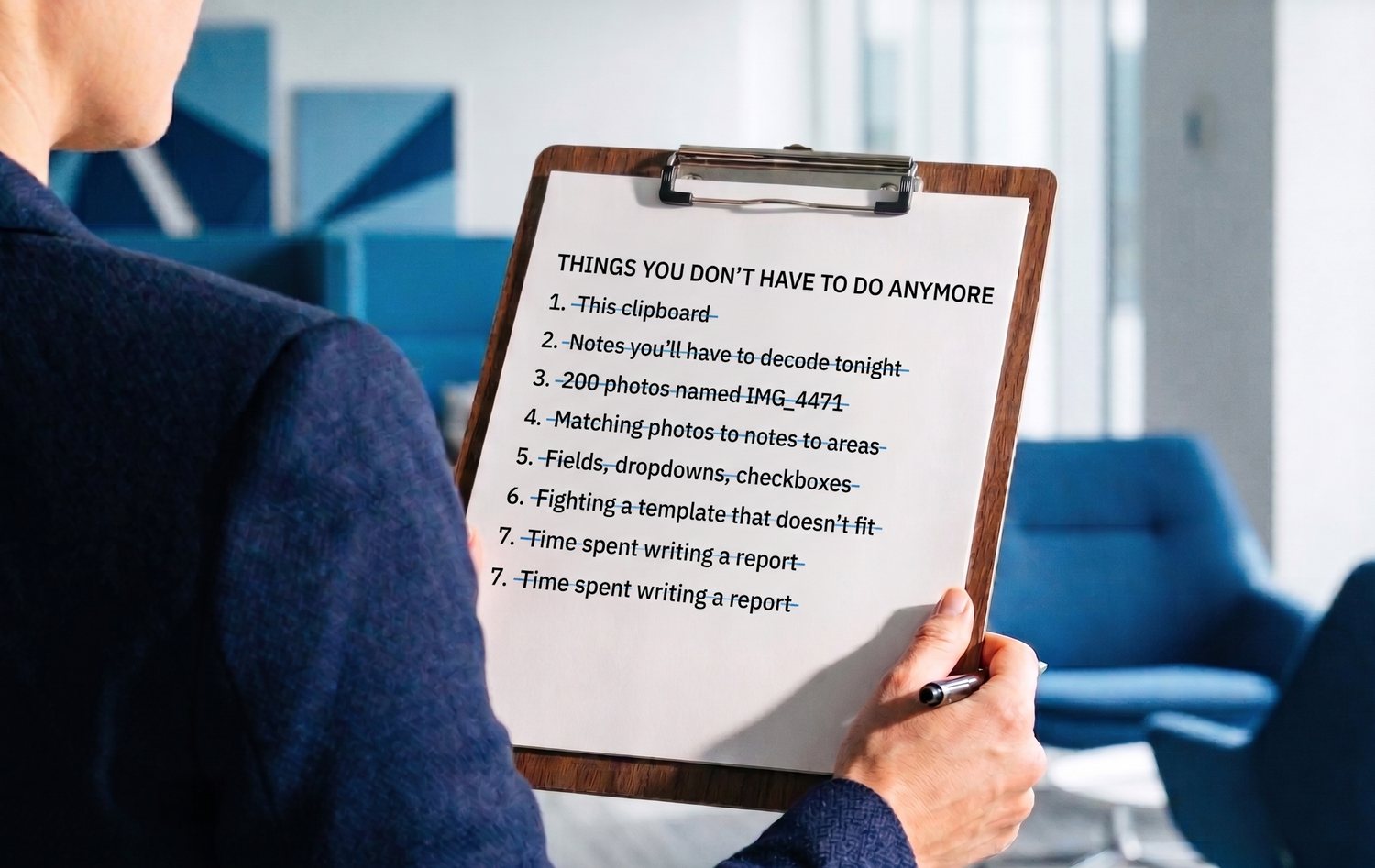
There's the observation and then the report, and the report often takes longer than the observation itself.
The observation you were already doing produces the finished report. There is no second job waiting at the end of the day, because the observation delivered the document.
The work ends when the observation ends, not hours later at a desk.
The time the report used to take is time you can actually sell.
No backlog waiting on the part nobody wants to do.
They get you halfway. Then they hand the rest back to you — in the field, standing up, one interruption at a time.
Your train of thought breaks every time you look down.
The tool captures fragments. Finishing the report is still on you.
You say less than you'd say out loud, because entering it costs more.
Say everything that matters, in the order it matters, at the level of detail you'd naturally use out loud — nothing gets shortened to fit a box.
Everything after that is an attempt to keep it intact.
You take in everything at once — condition, context, what matters and what doesn't. That judgment is the whole value of what you do.
Your attention leaves the thing you came to look at.
You record what you had time for, not what you noticed.
Hours later, from fragments, away from the thing itself.
Say it the way you'd say it to someone standing next to you. ScribeCam writes the professional report from what you meant.
The report represents the observation. Not the notes.
The meaning was in your head the second you pressed the shutter. Getting it into the report means putting it back in by hand.
The file only knows what time it was taken.
Ordered, captioned and dropped into the right section, one at a time.
The ones you can't explain quietly get left out.
The photo, your words, and the place it belongs arrive together and stay together.
Some observations are meant to be repeatable — the same steps, the same coverage, every visit, whoever turns up.
Build the checklist once. It rides along on screen while you record, so the job gets covered the same way every time — without ever pulling you out of the observation.
Your steps, in your order, in your wording — for the jobs that should always look the same.
A guide in view as you record, so nothing gets missed and nothing needs remembering.
What was covered is part of the record, not something you have to attest to afterwards.
It won't tell you what matters — you already know that. What it does is make sure you never drive away wondering what you forgot.
Say it in fragments. Say it out of order. Say it the way it comes out of your mouth. The standard of the document never depends on how well you put sentences together.
“Yeah so — this bit here on the left, it's cracked pretty bad, runs about two foot.”
Talks in fragments“Cracking. Left side. Significant. About two feet.”
Clipped and fast“There's fairly significant cracking running along the left-hand side, roughly two feet.”
Full sentencesSignificant cracking was observed to the left-hand side, extending approximately two feet in length. The condition was noted during the walkthrough and is identified as an area requiring attention.
Photographs of the affected area are included in this section.
Being excellent at the observation and being a report writer aren't the same job.
The fifth report of the day never gets the care the first one did.
It should carry the same professionalism as the observation behind it.
The context is your spoken word. A photo shows something; what you say about it is what gives it meaning — and ScribeCam never guesses at either. Say it however it comes out of your mouth, and it comes back written professionally.
A quick correction in the field, or a full pass at a desk — both are there, and neither one starts you over.
Every save creates a version, and every version keeps its own PDF and its own online copy. The original stays the original. You can open any point in that history — the first report, the one you sent last Tuesday, or the one you finished a minute ago.
Some people want a PDF they can file. Others just want to open something on their phone. ScribeCam produces both from the same report, at the same moment.
Attach it to an email, drop it in a folder, print it, send it to a client. Nothing proprietary, nothing to install on their end.
Send the custom link however you already talk to people — text, email, Teams. It opens on any phone or computer, with no app to download.
The online report has its own custom link, and you decide who gets in. Whoever opens that link confirms an email address you granted access to — new recipients set up a free viewing account in seconds, and anyone who already has ScribeCam simply signs in. If the custom link is passed along to someone you didn’t approve, it doesn’t open for them. You can see who has viewed it and when.
Everything a report produces is kept in your ScribeCam Vault — not just the finished document, but the material behind it. Phones get lost, replaced and wiped. The Vault doesn’t.
The complete Report Bundle zip for that job, exactly as your device sealed it.
Each version you saved keeps its own PDF — the first one and every one after it.
The recordings behind the report, every photo, and each highlight clip cut from them.
The web version stays live, so a link you sent months ago still opens.
A sealed bundle is held for 90 days from the day it lands in your Vault. Every item shows its own date, and the dashboard warns you before one lapses — so nothing disappears quietly.
Paid plans can carry more Vault storage, and you can always keep your own copy — the bundle downloads from the report, and it files itself into your iCloud or Drive if you connect one.
Delete a report from your Vault at any time, from the web app or straight off your phone. It goes when you say so — and any copy you already kept still verifies.
When a report is sealed, ScribeCam packages the whole record — the video, your spoken words, every photo, the sensor data and the finished report — into a single zip file. Open it on any computer. Nothing to install.
└─ Roof Inspection — 4218 Marlow Ave/ ├─ Start Here — How to Use This File.pdf ├─ Report/ the finished report ├─ Media Files/ │ ├─ Videos/ full, unedited recordings │ ├─ Video Clips/ highlight clips, by recording │ └─ Photos/ every photo, by recording ├─ Recording Data/ transcripts, sensors, image labels └─ Proof of Authenticity/ ├─ Certificate of Authenticity.pdf ├─ manifest.json the itemized receipt ├─ seal.json fingerprint + signature └─ timestamp.tsr independent time token
The bundle is assembled and sealed on the device that recorded it, before anything is uploaded. Every other copy comes from that one.
It uploads to your ScribeCam account, where you can sign in and download it from the report at any time.
Connect iCloud or Drive and the phone files each sealed bundle into a ScribeCam / Report Bundles folder for you. Off until you turn it on — and it is storage you control.
A certificate, an itemized receipt of every file, a fingerprint of the whole package and an independent timestamp from outside ScribeCam. Together they let anyone confirm the bundle is exactly what your device produced, years later, without an account and without asking us. See how court-grade sealing works
It is rarely a dispute. A client wants reassurance the work was done. A company wants a record it can stand behind. An owner, an insurer, an attorney — each has their own reason to look, and none of them were standing where you were.
The recording, your words, the photos and where you were are captured as the observation happens — not written up from memory afterwards.
Photos are taken through ScribeCam, inside the report they belong to. Nothing is pulled in from a camera roll or a folder somewhere else.
Sealed on the phone before it uploads, with an independent trusted timestamp. Checkable years later, by anyone, without a ScribeCam account.